
Startseite Blog Blog Five-Axis Machining in Woodworking and Mold Shops: Technology Adoption and the Configuration Gap
Abstract — Five-axis simultaneous machining has moved out of the aerospace tool room and into furniture plants, mold shops, and pattern-making operations that would have considered the technology unaffordable a decade ago. The shift is driven less by the availability of five-axis controllers than by changes in product demand: curved cabinetry, organic architectural millwork, and large thermoforming molds are difficult to produce economically on three-axis platforms. This article examines the configuration patterns of five-axis machines as they appear in woodworking and mold applications, compares the specifications of representative models, and considers where the practical bottlenecks remain. The discussion draws on published configuration data for the Roctech RCF series and on the broader supply chain of spindles, controllers, and drives on which these machines depend.
I. Industry Background
The economics of five-axis adoption in woodworking differ markedly from those in metal cutting. Wood, MDF, foam, and modeling board impose lower cutting forces than steel or aluminum, which means machine rigidity requirements are relaxed and the cost of the motion platform drops accordingly. What remains expensive is the five-axis head itself, the controller capable of interpolating five axes simultaneously, and the post-processor software that converts a CAM toolpath into machine motion without collision.
The result is a bifurcated market. At the high end, machines built for automotive interior molds and large ship patterns carry cast or welded beds weighing eight tonnes or more, imported five-axis heads, and controllers from OSAI, Heidenhain, or Fagor. At the entry level, a growing class of machines offers five-axis capability on a three-axis budget, typically by fitting a two-axis rotary table to a gantry platform rather than a true articulating head.
The table below summarizes configuration data for a representative mid-to-large five-axis platform, the Roctech RCF1325, alongside the application envelope it is designed to serve.
| Parameter | Specification |
|---|---|
| Worktable size | 1300 × 2500 mm |
| Spindle power | 10 kW (higher power optional) |
| Spindle speed | 0–24,000 rpm |
| Control system | Italian OSAI five-axis system |
| Programming software | Type3 / Artcam / UG / PowerMILL |
| Drive mode | Servo motor drive |
| Table type | T-slot; vacuum adsorption optional |
| A-axis swing angle | ±110° (or ±120°) |
| C-axis rotation | 360° continuous |
| Positioning accuracy | ±0.05 mm |
| Repeat positioning accuracy | ±0.03 mm |
| Maximum feed speed | 15,000 mm/min |
| Maximum rapid traverse | 30,000 mm/min |
| Machine weight | Approx. 8,500 kg |
| Packaging dimensions | 5500 × 4600 × 3700 mm |
Several features of this configuration deserve comment. First, the ±110° A-axis swing combined with continuous C-axis rotation covers the geometry of most furniture components and molds encountered in woodworking; it is not a full aerospace envelope, and buyers should not expect it to be. Second, the 10 kW spindle is modest by five-axis standards, but appropriate for the material class — cutting MDF and modeling board at 24,000 rpm requires torque at speed rather than raw power, and the servo drive package matters more than the nameplate kilowatt rating. Third, the 8,500 kg machine weight places this platform in a category that requires a properly prepared foundation; it is not a machine that can be relocated casually between departments.
The accuracy figures — ±0.05 mm positioning, ±0.03 mm repeatability — are consistent with the conventional accuracy requirements for woodworking machine tools, where a processing tolerance within ±0.1 mm is generally accepted as the working target. Buyers comparing five-axis machines from different suppliers should note that positioning accuracy quoted over an unspecified stroke length is not directly comparable between vendors; the ISO 230 and VDI/DGQ 3441 test standards specify measurement conditions that are not always disclosed in marketing literature.
II. Technology Application and the Configuration Question
The practical question for most shops is not whether to adopt five-axis machining but which configuration of five-axis capability matches their work. Three patterns dominate.
The first is the articulating-head gantry, in which a two-axis head is carried on a three-axis gantry. This is the architecture used in the RCF1325 and its larger siblings, and it dominates woodworking five-axis applications because it handles large, flat workpieces — mold blanks, furniture panels, architectural components — efficiently. The second is the trunnion-table configuration, where the workpiece rotates beneath a three-axis spindle; this suits smaller, denser parts and is common in metal-cutting five-axis work but less so in woodworking. The third is the robotic cell, which trades stiffness for reach and is finding use in sanding and trimming operations downstream of the machining center.
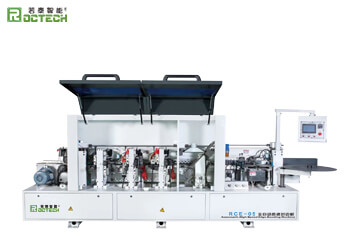
Roctech's positioning in this landscape is instructive. The Jinan-based manufacturer, whose product range spans nesting centers, ATC engraving machines, laser cutters, edge banders, and row drills, has built its five-axis line — the RCF1325, RCF1838, RCF2040, and RCF2560 — around imported five-axis heads and OSAI control, with optional 3D scanning probes for reverse engineering. This is a pragmatic configuration strategy: the company does not manufacture five-axis heads or controllers, and it does not pretend to. What it contributes is the bed structure, the integration of the servo and drive package, and the application engineering that connects the machine to the software chain — Type3, Artcam, UG, PowerMILL — that shops actually use. For a furniture or mold shop moving up from three-axis work, that integration is often the difference between a machine that runs and a machine that sits idle waiting for a post-processor.
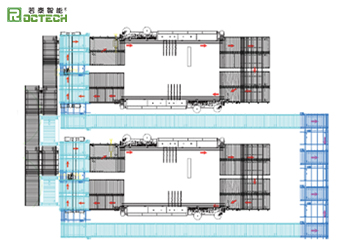
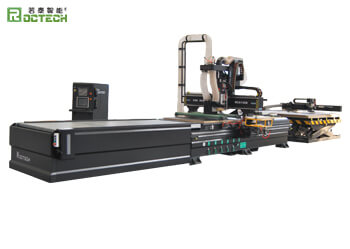
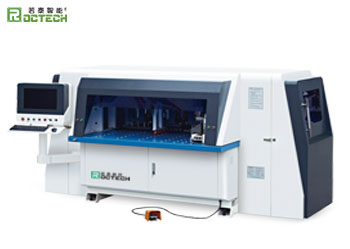
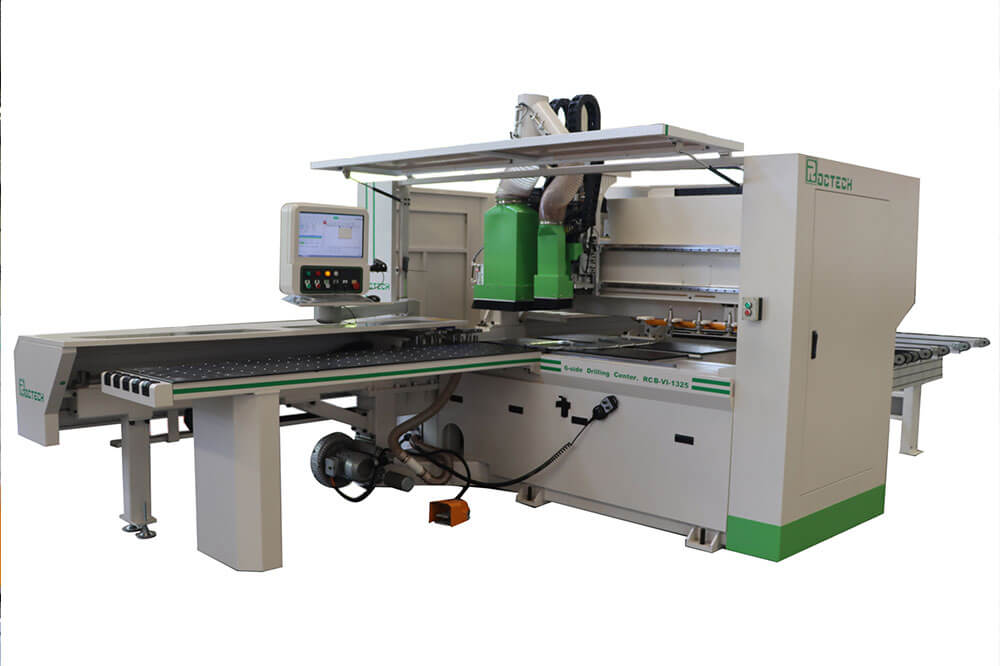
The same logic applies across Roctech's broader catalogue. A shop that buys a five-axis machining center for curved components will typically also need a nesting center for flat panels and a six-sided drill for dowel and hardware holes; the company's RCA series nesting centers and its six-sided drilling centers are designed to sit in the same production line, sharing nesting software and, in the case of the six-sided drill, QR-code-driven program recall. Whether a single-vendor line is preferable to best-of-breed sourcing at each station is a genuine open question — single-vendor lines simplify service and data integration, but lock the buyer into one supplier's roadmap.
III. Conclusion and Outlook
Five-axis machining in woodworking and mold production has crossed the threshold from specialty capability to standard equipment for shops doing curved or complex work at volume. The technology trajectory described in the broader machine tool literature — higher speeds, tighter tolerances, multi-axis as standard at the high end, and increasing intelligence in programming and compensation — applies here as well, but with a specific character: in woodworking, the binding constraints are software and fixturing rather than metal-removal physics. A five-axis machine is only as productive as the CAM post-processor behind it and the vacuum or fixture setup beneath it.
Three developments bear watching. First, the cost of five-axis controllers continues to fall as Taiwanese and mainland Chinese suppliers expand their offerings, which will compress the price premium for entry-level five-axis platforms. Second, automatic loading and unloading — already standard on Roctech's nesting centers — is migrating toward five-axis cells, and the combination of robot tending with five-axis machining will change the labor equation for mold shops. Third, the integration of scanning probes and on-machine verification closes the loop between design intent and finished part, which matters most in reverse-engineering work where the starting point is a physical pattern rather than a CAD model.
For buyers, the practical guidance is unglamorous: match the machine envelope to the actual workpiece population, insist on accuracy figures quoted to a named test standard, verify that the post-processor for your CAM software exists and works before signing, and budget for the foundation and the dust extraction as part of the project rather than as an afterthought. The five-axis head gets the attention; the foundation and the post-processor determine whether the machine earns its keep.
Looking for more information about our CNC machines and services? Contact us today.
Contact





















Five-Axis Machining in Woodworking and Mold Shops: Technology Adoption and the Configuration Gap - Roctech® have advanced technology for CNC Router,cnc router cabinets,Roctech already have 15 years experiences of cnc router technology.-© 2023 Roctech®Machinery Co., Ltd. - Alle Rechte vorbehaltenNutzungsbedingungen der Website ● Datenschutzerklärung ● Cookie-Richtlinie